NPS vs PPF vs ELSS 2026 - Best Tax Saving Investment Comparison Guide (Returns + Lock-in)
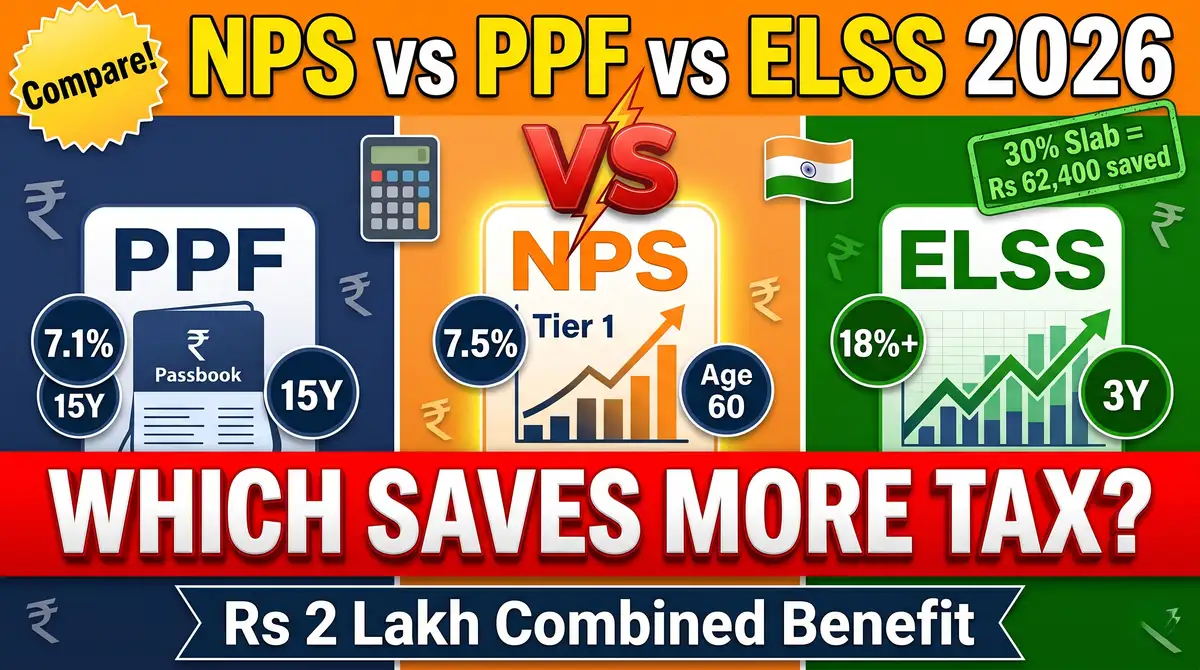
⚡ 30-SECOND SUMMARY
Overview
Key Points:
📄 Complete Guide▾
NPS vs PPF vs ELSS 2026 - Best Tax Saving Investment Comparison
Bhaiyon, financial year 2026-27 start ho gaya - aur har salaried/self-employed ke mind me yahi sawaal: PPF, NPS, ya ELSS - kaunsa best? Sach yeh hai ki teeno different purposes serve karte hain - PPF safety, NPS retirement, ELSS wealth creation. Smart investor teeno ko mix karke Rs 1.5 lakh (Section 80C) + Rs 50K extra (80CCD(1B) NPS) = Rs 2 lakh tax saving + maximum wealth corpus build karta hai. Ye guide tumhe head-to-head comparison + age-wise recommendation + real return calculation dega.
30% tax bracket me Rs 2 lakh deduction = Rs 60,000 tax saving annually. Plus 20-30 saal mein wealth corpus Rs 1-2 crore tak ja sakta hai - agar smartly invest karo.
NPS vs PPF vs ELSS - Quick Comparison Table
| Feature | PPF | NPS Tier 1 | ELSS |
|---|---|---|---|
| Returns (Annual) | 7.1% (fixed, tax-free) | 7.5% avg market | 18%+ avg market |
| Lock-in Period | 15 years | Till age 60 | 3 years (lowest!) |
| Tax Benefit | Rs 1.5L (80C) | Rs 2L (80CCD) | Rs 1.5L (80C) |
| Tax on Maturity | Fully tax-free (EEE) | 60% lump tax-free + 40% annuity taxable | LTCG 12.5% above Rs 1.25L |
| Min Investment | Rs 500/yr | Rs 1,000/yr | Rs 500/SIP |
| Max Investment | Rs 1.5L/yr | No limit | No limit |
| Risk | Zero (govt-backed) | Low-Medium | High (equity) |
| Liquidity | Very low (15Y) | Very low (60-yr) | Medium (3Y) |
| Best For | Safety + retirement | Retirement + extra tax | Wealth + short lock-in |
Key Insight: PPF + NPS = pure safety+retirement. ELSS = highest returns but market-linked.
Returns Comparison - Rs 1.5 Lakh Annually for 15 Years
| Investment | Total Invested | Maturity Corpus | Net Profit |
|---|---|---|---|
| PPF (7.1%) | Rs 22.5 Lakh | Rs 40.7 Lakh | Rs 18.2 Lakh |
| NPS (8% avg) | Rs 22.5 Lakh | Rs 43.9 Lakh | Rs 21.4 Lakh |
| ELSS (12% avg) | Rs 22.5 Lakh | Rs 56.7 Lakh | Rs 34.2 Lakh |
| ELSS (15% avg) | Rs 22.5 Lakh | Rs 71.5 Lakh | Rs 49 Lakh |
15 years me ELSS PPF se Rs 16-30 lakh extra. But market risk - returns guaranteed nahi. PPF/NPS guaranteed.
Tax Benefit - Section-Wise Breakdown
| Section | Limit | Eligible Investments |
|---|---|---|
| 80C | Rs 1.5 lakh | PPF, ELSS, EPF, LIC, NSC, SSY, Tax FD, Home loan principal |
| 80CCD(1) | (Within 80C) | NPS Tier 1 contribution |
| 80CCD(1B) | Rs 50,000 extra | NPS Tier 1 ONLY |
| 80CCD(2) | No limit | Employer NPS contribution (10%/14% Basic+DA) |
Total Maximum Tax Saving (Old Regime)
- 80C (PPF + ELSS + LIC) = Rs 1.5 lakh
- 80CCD(1B) (NPS extra) = Rs 50,000
- Total deduction = Rs 2 lakh
- 30% slab tax saving = Rs 60,000/year
NPS unique advantage: Sirf NPS me Rs 50K extra (80CCD(1B)) milta hai - PPF/ELSS me ye nahi.
Risk Profile + Suitability
PPF - Zero Risk
- Govt of India sovereign guarantee - return + principal both
- Interest rate quarterly review by Finance Ministry
- Best for: Conservative investors, retirees, risk-averse
NPS - Low-Medium Risk
- Market-linked but auto-balanced (lifecycle funds)
- Equity exposure capped at 75% (auto reduction with age)
- Best for: Salaried, retirement-focused (long horizon)
ELSS - High Risk, High Return
- 100% equity - market volatility full exposure
- Past 5-year avg 18-20% but year-to-year volatile (-20% to +35%)
- Best for: Young investors (25-40), wealth creation, high risk tolerance
Age-Wise Recommendation Strategy
Age 25-35 (Aggressive)
- ELSS: 60% (Rs 90K) - high equity for long compounding
- NPS: 30% (Rs 45K) - retirement seed
- PPF: 10% (Rs 15K) - safety token
Age 35-50 (Balanced)
- ELSS: 40% (Rs 60K)
- NPS: 35% (Rs 52.5K) + Rs 50K (80CCD(1B))
- PPF: 25% (Rs 37.5K)
Age 50-60 (Conservative)
- PPF: 50% (Rs 75K)
- NPS: 40% (Rs 60K + 80CCD(1B))
- ELSS: 10% (Rs 15K)
Plus full Rs 50,000 in NPS 80CCD(1B) at all ages for max tax benefit.
Annual Tax Saving Calculation (30% Slab)
| Strategy | Investment | Tax Deduction | Tax Saved |
|---|---|---|---|
| Only PPF | Rs 1.5L | Rs 1.5L | Rs 46,800 |
| Only ELSS | Rs 1.5L | Rs 1.5L | Rs 46,800 |
| Only NPS Tier 1 | Rs 2L (1.5L + 50K) | Rs 2L | Rs 62,400 |
| Combined: ELSS Rs 1.5L + NPS Rs 50K | Rs 2L | Rs 2L | Rs 62,400 |
NPS combined with ELSS = best of both worlds. 30% slab me Rs 62,400/year tax saving + 17% avg ELSS returns + 7.5% NPS market returns.
Liquidity + Withdrawal Comparison
| Scheme | Premature Withdrawal | Loan Facility |
|---|---|---|
| PPF | After 5 years (1 per year, restricted) | After 1 year (up to 25% balance) |
| NPS | After 5 yrs - 20% lump + 80% annuity | No loan facility |
| ELSS | 3-year lock-in over = 100% liquidity | No loan |
ELSS lock-in shortest (3 years) - emergency funds ke liye best among 80C options.
NPS vs PPF vs ELSS FAQs
Q: PPF, NPS, ELSS - mein ek hi choose karna ho to? A: Salaried + 30% slab: NPS Tier 1 (Rs 2L tax benefit highest). Risk-averse: PPF (zero risk + tax-free). Young + wealth-focused: ELSS (highest returns + 3Y lock-in).
Q: Teeno me invest kar sakte hain? A: HAAN - recommended strategy. PPF Rs 50K + NPS Rs 50K + ELSS Rs 50K = Rs 1.5L (80C exhaust) + extra Rs 50K NPS (80CCD(1B)) = Rs 2L total deduction.
Q: ELSS me 18% guaranteed hai? A: NO - market returns. Past 5-year avg 18%+ lekin year-to-year negative bhi ho sakta hai. Long-term (10+ years) me 12-15% likely.
Q: NPS premature withdrawal ka rule? A: 5 years complete ke baad - 20% lump sum + 80% annuity (mandatory). PPF: 5 years partial, 15Y full. ELSS: 3-year lock-in then 100%.
Q: New tax regime me kya kaam aate hain ye? A: New tax regime me 80C/80CCD(1B) deduction NAHI milta (sirf 80CCD(2) employer NPS milta hai). Old regime select karne wale hi 3 schemes ka tax benefit le sakte hain.
Q: Best returns kis me hai 15-year horizon me? A: ELSS (12-15% avg = Rs 56-71 lakh) > NPS (8% = Rs 44 lakh) > PPF (7.1% = Rs 40.7 lakh) at Rs 1.5L/year invest.
Related Finance Guides
- NPS Complete Guide 2026 - Tier 1 + Tier 2 details
- NPS Vatsalya Scheme 2026 - Children Pension Account - Below 18 NPS variant, Rs 1.5 cr corpus, 80CCD(1B) Rs 50K
- PPF Account Open Online 2026 - 7.1% tax-free guide
- ELSS Mutual Funds 2026 Top Picks - Best fund selection
- Section 80C Tax Saving Guide 2026 - All 80C options
- New vs Old Tax Regime 2025-26 - Regime selection
- ITR Filing 2026 Guide - Tax filing process
- LIC Policy Surrender Ya Paid-Up - bima aur bachat alag karne ka pehla kadam
- Mutual Fund vs Stocks - baazaar wale do raaste
Source: ClearTax + Bajaj Finserv + Angel One + Axis Max Life + Tata AIA cross-verified. Returns based on 5-year historical averages (NPS LIC PF + ELSS top funds). Past performance not indicative of future returns. Verified 29 April 2026.
🔗 IMPORTANT LINKS
Is Page ka Author
Abhishek - SkillUP Bihar
Personal Finance Writer (Students & Govt Employees)
Content Writer. Official govt sources se verified content likhta hai. Bihar sarkari naukri focus. Har page kam-se-kam 2 official sources se cross-verified.
Verified by Md Saiyad Ali - Founder & Content Researcher
Related Finance Articles
Dairy Loan Aur Subsidy
Gavya Vikas Yojana me 75, 50 ya 40 pratishat anudan milta hai - par wo paisa aapke haath me pehle nahi aata. Pehle bank ka loan aur aapki margin money lagti hai; pashu, bima aur pashushala ke baad BANK vibhag se anudan ka dawa karta hai, jo aapke LOAN khaate me jaata hai. Poora kram official maarg-nirdeshika se.
Banking & FinancePashupalan Matsya KCC
KCC sirf fasal ke liye nahi hai. 2019 se usme pashupalan, dairy evam matsya bhi aa gaye - aur inke liye jameen honi zaroori nahi. Bhoomiheen pashupalak bhi le sakta hai. Rs 2 lakh tak koi gaarantee nahi (RBI ka 6 December 2024 ka aadesh), aur byaj samay par chukane par 7 se ghatkar 4 pratishat reh jaata hai.
BankingCurrent Account Guide
Chhote dhandhe wale apna poora lenden ghar ke savings khaate se chalate hain, aur jab loan ki zaroorat padti hai to bank ke saamne dikhane ko kuch nahi hota. Current account kya hai, savings se kya fark, kaun se kaagaz lagte hain, aur minimum balance ka asli kharch - poora hisaab.
BankingAccount Types Guide
Bank khaate teen tarah ke hote hain aur unka fark minimum balance par tikta hai. 1 April 2026 se har bank ko zero-balance (BSBDA) khaata dena anivarya hai jisme minimum balance ki koi shart nahi. Salary account ka faayda kab tak chalta hai, naukri badalne par kya karein, aur charge kahan se lagta hai.
Banking & FinanceITR Common Mistakes 2026
ITR file karte waqt ye 8 common galtiyan refund atka deti ya income tax notice laati hain - galat ITR form, e-verify bhulna, Form 26AS/AIS mismatch, galat regime, wrong bank account. Last date 31 July se pehle inse bacho - full checklist yahan.
Banking & FinanceFreelancer ITR 2026
Freelancer/self-employed ho? ITR-4 (presumptive 44ADA - 50% income, gross Rs 50-75 lakh tak) ya ITR-3 (regular books) bharo. Old regime chahiye to Form 10-IEA. Advance tax (liability Rs 10,000+), GST + filing process - full guide tight aur clear.