NSC vs KVP 2026 - Post Office Schemes Compared (7.7% vs 7.5%, Tax + Maturity Guide)
⚡ 30-SECOND SUMMARY
Overview
Key Points:
📄 Complete Guide▾
NSC vs KVP 2026 - Post Office Tax Saver vs Money Doubler Schemes
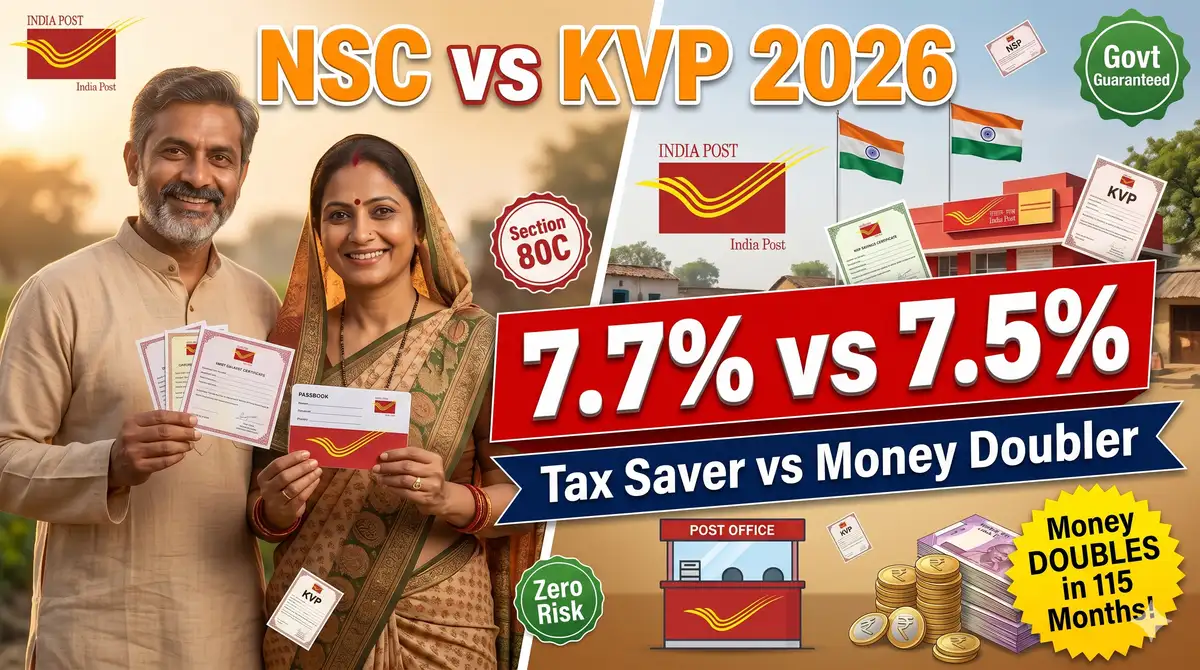
Bhaiyon, NSC (National Savings Certificate) + KVP (Kisan Vikas Patra) dono Post Office ke popular small savings schemes hain - lekin alag purposes serve karte hain. NSC = 7.7% + Section 80C Rs 1.5 lakh tax saver (5-year lock-in), KVP = 7.5% + money doubles in 115 months (no tax benefit). Q1 FY 2026-27 rates unchanged since April 2025 - 8th consecutive quarter stable. Govt-backed sovereign guarantee = zero risk. Bihar/UP rural audience me especially popular - bank account na ho to post office se apply kar sakte ho. Ye guide tumhe head-to-head comparison + tax implications + apply process sab dega.
Quick Decision: Tax saving chahiye? NSC choose karo (80C eligible). Money doubling chahiye, tax benefit nahi? KVP (faster maturity guarantee).
NSC vs KVP 2026 - Quick Comparison
| Feature | NSC | KVP |
|---|---|---|
| Full Form | National Savings Certificate | Kisan Vikas Patra |
| Interest Rate (Q1 FY26-27) | 7.7% p.a. | 7.5% p.a. |
| Compounding | Annually | Annually |
| Maturity Period | 5 years (60 months) | 115 months (~9 yrs 7 mo) |
| Min Investment | Rs 1,000 | Rs 1,000 |
| Max Investment | No limit | No limit |
| Tax Benefit (80C) | YES - Rs 1.5 lakh | NO |
| Interest Taxable? | YES (slab rate) | YES (slab rate) |
| Lock-in / Premature | 5-year lock-in (no early exit typically) | After 2.5 years (lower rate) |
| Money Doubles in | ~10 years (at 7.7%) | Guaranteed in 115 months |
| TDS | NO (no TDS deduction) | NO |
| Best For | Tax saving + safety | Fixed-term wealth doubling |
NSC (National Savings Certificate) 2026 Details
Key Features
- Issued by: Department of Posts, Govt of India
- Tenure: 5 years (fixed)
- Interest: 7.7% p.a. compounded annually, paid at maturity
- Investment denominations: Rs 1,000, Rs 5,000, Rs 10,000, Rs 1 lakh
- Min investment: Rs 1,000 | No upper limit
- Joint account: Up to 3 adults
Tax Benefits (Section 80C)
- Investment up to Rs 1.5 lakh deduction (combined 80C cap)
- Interest re-invested = qualifies for fresh 80C deduction (years 1-4)
- 5th year interest = taxable (no re-investment)
- No TDS on NSC interest (lekin slab rate per ITR me declare karna hota hai)
Calculation Example (Rs 1 Lakh in NSC at 7.7%)
| Year | Balance |
|---|---|
| Year 0 | Rs 1,00,000 |
| Year 1 | Rs 1,07,700 |
| Year 2 | Rs 1,16,000 |
| Year 3 | Rs 1,24,931 |
| Year 4 | Rs 1,34,549 |
| Year 5 (Maturity) | Rs 1,44,910 |
Total interest Rs 44,910 in 5 years. Years 1-4 interest reinvested (80C eligible). Year 5 interest taxable.
KVP (Kisan Vikas Patra) 2026 Details
Key Features
- Issued by: Department of Posts (originally for farmers, open to all)
- Tenure: 115 months (9 yrs 7 mo) - money doubles
- Interest: 7.5% p.a. compounded annually
- Investment denominations: Rs 1,000, Rs 5,000, Rs 10,000, Rs 50,000
- Min investment: Rs 1,000 | No upper limit
- Lock-in: 2.5 years (premature withdrawal allowed but lower rate)
Tax Treatment
- No 80C tax benefit (NOT a tax saver)
- Interest fully taxable as per slab rate
- No TDS at maturity
- Capital gains tax NOT applicable (interest income only)
Money Doubling Calculation (Rs 1 Lakh in KVP at 7.5%)
- Maturity value: Rs 2,00,000 (guaranteed)
- Maturity period: 115 months exactly
- Effective doubling rate: 7.5% compounded
Premature Withdrawal Rules
- Before 2.5 years: Not allowed (except death/court order)
- After 2.5 years: Allowed at lower interest rate
- At maturity: Full doubled amount
KVP Unique Features (vs NSC)
- Collateral/Pledge: KVP can be used as security for secured loans (NSC also)
- Certificate Types: Single Holder / Joint A (jointly/survivor) / Joint B (either/survivor)
- Minor Account: Allowed with guardian (parent) consent
- Transfer Allowed: Heirs (death case), court orders, joint holders, close relatives (after 1 year)
- Nomination: Form C - single + joint holders both can nominate
How to Apply for NSC / KVP
Method 1: Post Office Branch (Most Common)
- Visit nearest Post Office (any in India)
- Form NSC-1 / KVP-1 fill (free at counter)
- Aadhaar + PAN + photo + filled form submit
- Cash / Cheque / DD payment
- Certificate issued within same day (Rs 1L+ takes 1-2 days)
Method 2: Authorized Banks
- SBI, PNB, Bank of Baroda, Canara, Indian Bank - select branches
- Same form + KYC process
- E-mode certificate (digital) preferred
Method 3: Online (E-Mode)
- India Post Payments Bank (IPPB) app/portal
- Existing PO savings account holder direct
- Aadhaar e-KYC + UPI payment
Documents Required (Both)
- Aadhaar Card (mandatory)
- PAN Card (Rs 50,000+ investment)
- Passport size photo (2)
- Address proof (utility bill / bank statement)
- Bank account details (for maturity credit)
NSC vs KVP - Which Should You Choose?
Choose NSC If:
- ✅ Want Section 80C tax deduction (Rs 1.5L cap)
- ✅ 5-year horizon acceptable
- ✅ Conservative + safe + tax-saver
- ✅ Salaried in old tax regime
- ✅ Senior citizen looking for guaranteed returns + tax benefit
Choose KVP If:
- ✅ Long horizon (10 years) + want guaranteed doubling
- ✅ NO tax benefit needed (already 80C exhausted via PPF/ELSS)
- ✅ Rural/farmer audience preferring Post Office
- ✅ Want fixed maturity date promise (115 months exact)
- ✅ New tax regime (anyway no 80C benefit)
Avoid Both If:
- ❌ High inflation worry - returns barely beat inflation (7-8% vs 5-6% inflation = 1-2% real return)
- ❌ Wealth creation focus - ELSS/equity mutual funds 12-18% better
- ❌ Liquidity needed - both have lock-in restrictions
NSC + KVP vs Other Small Savings (Q1 FY 2026-27)
| Scheme | Interest | Tenure | Tax Benefit |
|---|---|---|---|
| PPF | 7.1% | 15 years | Rs 1.5L 80C + EEE |
| NSC | 7.7% | 5 years | Rs 1.5L 80C |
| KVP | 7.5% | 115 months | None |
| SCSS (Senior Citizen) | 8.2% | 5 years | Rs 1.5L 80C |
| SSY (Girl Child) | 8.2% | 21 years | Rs 1.5L 80C + EEE |
| MIS (Monthly Income) | 7.4% | 5 years | None |
| Time Deposit (5Y) | 7.5% | 5 years | Rs 1.5L 80C |
Highest interest: SCSS + SSY at 8.2% (specific eligibility). Tax-free both ways: PPF + SSY only (EEE).
NSC + KVP 2026 FAQs
Q: NSC me kitna invest karna chahiye 2026 me? A: Rs 1.5 lakh (max 80C cap). Combined with PPF/ELSS - sab Rs 1.5L tak deduction. Above Rs 1.5L invest sirf safety ke liye.
Q: KVP me 80C benefit milta hai? A: NO - KVP is NOT a tax saver. Sirf guaranteed doubling investment hai. NSC 80C eligible, KVP nahi.
Q: NSC interest taxable hai? A: HAAN slab rate - lekin years 1-4 interest reinvested = 80C eligible for that year (cumulative effect). Year 5 final interest fully taxable.
Q: KVP me money kab double hoti hai? A: Exactly 115 months (9 years 7 months). Rs 1 lakh = Rs 2 lakh guaranteed. Premature: 2.5 years lock-in.
Q: NSC ya KVP - kaunsa better? A: Tax saving chahiye: NSC. Long horizon doubling guarantee: KVP. Most salaried = NSC better. Rural farmers/no-tax-need = KVP simpler.
Q: Rate kab change hote hain? A: Quarterly review by Finance Ministry. Q1 FY 2026-27 = unchanged 8th consecutive quarter. Next review July 2026.
Q: Online apply ho sakta hai NSC/KVP? A: Limited online - IPPB account holders direct. Most cases post office branch visit required for first time. Subsequent purchase online possible.
Related Finance Pages
- Post Office MIS 2026 - Monthly Income 7.4% - Har mahine fixed income (any age)
- Senior Citizen Savings Scheme (SCSS) 8.2% - 60+ buzurgo ke liye regular income
- Sukanya Samriddhi Yojana (SSY) 2026 - 8.2% Tax-Free - Beti ke liye sabse dum scheme
- PPF Account Open Online 2026 - 7.1% tax-free EEE
- Section 80C Tax Saving Guide 2026 - All 80C options
- Sukanya Samriddhi Yojana 2026 - 8.2% girl child
- NPS Complete Guide 2026 - Retirement planning
- Best FD Rates April 2026 - Bank fixed deposits
- ELSS Mutual Funds 2026 Top - Tax saver funds
Source: ClearTax + Bajaj Finserv + Upstox + India Post (indiapost.gov.in) + PayBima cross-verified. Q1 FY 2026-27 rates per Finance Ministry notification 30 March 2026. Verified 29 April 2026.
🔗 IMPORTANT LINKS
Is Page ka Author
Abhishek - SkillUP Bihar
Personal Finance Writer (Students & Govt Employees)
Content Writer. Official govt sources se verified content likhta hai. Bihar sarkari naukri focus. Har page kam-se-kam 2 official sources se cross-verified.
Verified by Md Saiyad Ali - Founder & Content Researcher
Related Finance Articles
Dairy Loan Aur Subsidy
Gavya Vikas Yojana me 75, 50 ya 40 pratishat anudan milta hai - par wo paisa aapke haath me pehle nahi aata. Pehle bank ka loan aur aapki margin money lagti hai; pashu, bima aur pashushala ke baad BANK vibhag se anudan ka dawa karta hai, jo aapke LOAN khaate me jaata hai. Poora kram official maarg-nirdeshika se.
Banking & FinancePashupalan Matsya KCC
KCC sirf fasal ke liye nahi hai. 2019 se usme pashupalan, dairy evam matsya bhi aa gaye - aur inke liye jameen honi zaroori nahi. Bhoomiheen pashupalak bhi le sakta hai. Rs 2 lakh tak koi gaarantee nahi (RBI ka 6 December 2024 ka aadesh), aur byaj samay par chukane par 7 se ghatkar 4 pratishat reh jaata hai.
BankingCurrent Account Guide
Chhote dhandhe wale apna poora lenden ghar ke savings khaate se chalate hain, aur jab loan ki zaroorat padti hai to bank ke saamne dikhane ko kuch nahi hota. Current account kya hai, savings se kya fark, kaun se kaagaz lagte hain, aur minimum balance ka asli kharch - poora hisaab.
BankingAccount Types Guide
Bank khaate teen tarah ke hote hain aur unka fark minimum balance par tikta hai. 1 April 2026 se har bank ko zero-balance (BSBDA) khaata dena anivarya hai jisme minimum balance ki koi shart nahi. Salary account ka faayda kab tak chalta hai, naukri badalne par kya karein, aur charge kahan se lagta hai.
Banking & FinanceITR Common Mistakes 2026
ITR file karte waqt ye 8 common galtiyan refund atka deti ya income tax notice laati hain - galat ITR form, e-verify bhulna, Form 26AS/AIS mismatch, galat regime, wrong bank account. Last date 31 July se pehle inse bacho - full checklist yahan.
Banking & FinanceFreelancer ITR 2026
Freelancer/self-employed ho? ITR-4 (presumptive 44ADA - 50% income, gross Rs 50-75 lakh tak) ya ITR-3 (regular books) bharo. Old regime chahiye to Form 10-IEA. Advance tax (liability Rs 10,000+), GST + filing process - full guide tight aur clear.